SBA Financing
SBA Loans Options to Grow your Business
Find your perfect lender matches from over 2,200 lending institutions, quickly & easily.

SBA Financing Options for Your Business
What is an SBA loan?
The Small Business Administration (SBA) is a U.S. government entity whose mission is “to maintain and strengthen the nation’s economy by enabling the establishment and viability of small businesses…”. As part of this mission, the SBA’s lending programs offers business loans that are partially guaranteed by the agency, meaning that the SBA will “stand behind” a portion of the loan. In other words, should a borrower default on their SBA loan, the SBA will reimburse the bank for a portion of its incurred losses. This guarantee reduces risk for bank lenders and in turn allows more American small businesses to access capital.
It’s important to note that the SBA does not originate SBA loans itself. Instead, the SBA workswith commercial banks and other approved financial institutions to originate the loans.
SBA Loan Programs
The SBA offers a variety of loan programs that differ based on loan size and purpose. Some of the terms in an SBA loan are standard and dictated by the SBA’s Standard Operating Procedures (maximum loan amount, loan maturity, maximum interest rates), while others vary widely lender-to-lender (effective interest rates, debt service coverage requirements, closing costs and fees). Popular SBA loan programs include 7(a) Loans, 7(a) International Trade Loans, 7(a) Export Working Capital Loans, and 504 Loans.
The SBA also provides dedicated programs for loans below $500,000, including 7a Small Loans, SBAExpress, Export Express, or Non-7a Microloans. More information on these loans can be found in the SBA’s Quick Reference guide.
It is important to note that the 7a program has the most broad applications and is one of the most common types of SBA loans. Specifically, the 7a structure provides a great option for business acquisitions, refinancing, working capital, or expansion capital for U.S. small businesses.
What kinds of businesses qualify for SBA 7a loans?
- Operate for profit
- Operate in an eligible industry
- Meet the SBA’s size standards of a “small business”
- Be engaged in business in the United States
- Use alternative financial resources, including personal assets, before seeking SBA financing
In addition, the owner or owners must be:
- U.S. citizens or Lawful Permanent Residents
- Willing to provide a personal guarantee
- Willing to provide 10-20% of cash equity if financing an acquisition
However, the SBA does have specific industries that are ineligible for SBA Loans. Those include gambling, lending, real estate investment, coin or stamp dealers, and charitable or religious organizations.
The Cerebro Solution
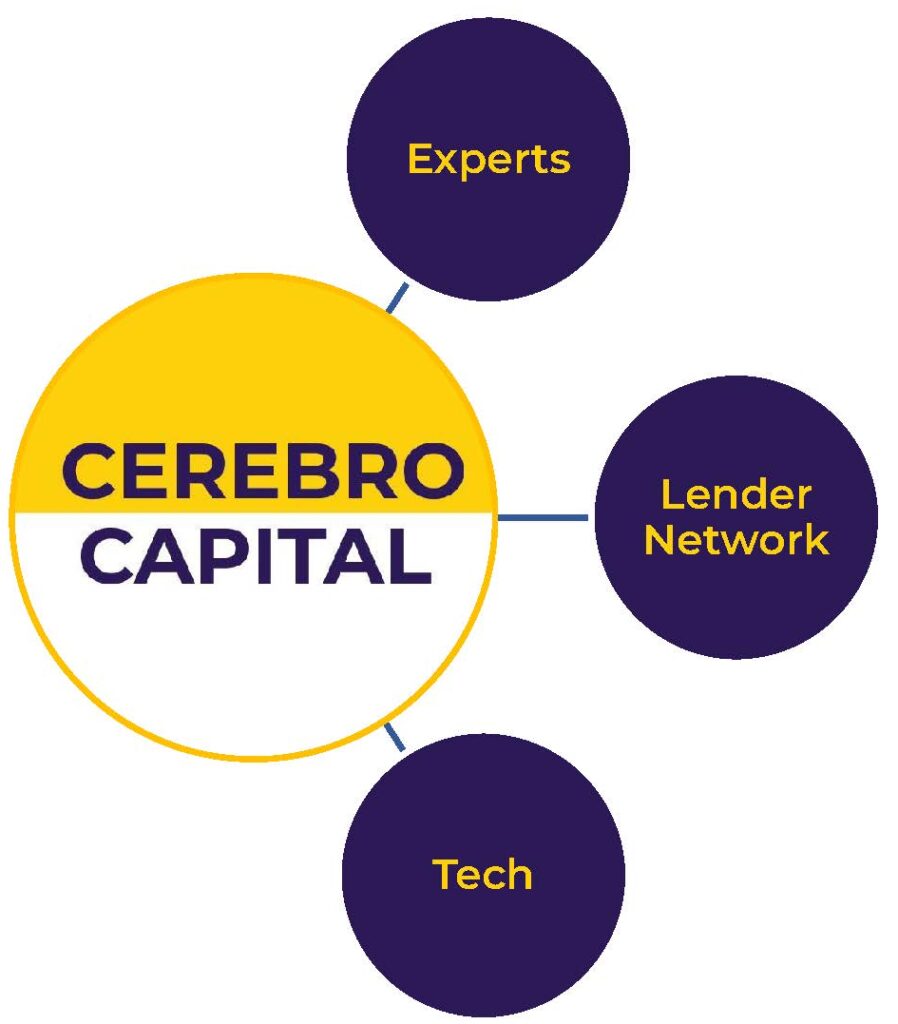
Team of Experts
- $7.7B committed loan proposals
- Over 150+ years combined lending experience
- Dedicated lending consultants
Lender Network
- 2,200+ Top Lenders
- Commercial banks & non-bank institutions
- Asset-based, cash-flow, mezzanine, acquisition, SBA & more
Technology
- Proven data-driven matching
- Patented platform
- Marketplace intelligence
Common Questions Regarding SBA Financing
What is SBA financing and how does it work?
SBA financing involves loans provided by approved lenders that are partially guaranteed by the U.S. Small Business Administration (SBA). This guarantee reduces the risk for lenders, enabling them to offer loans with more favorable terms, such as lower down payments, extended repayment periods, and competitive interest rates.
What can SBA loans be used for?
SBA loans are versatile and can be utilized for a variety of business needs, including working capital, purchasing equipment, facilitating real estate acquisitions, refinancing existing debt, and supporting business expansion. This flexibility makes SBA loans a popular choice for small and lower mid-market businesses.
How difficult is it to qualify for an SBA loan?
Qualifying for an SBA loan can be more rigorous compared to other financing solutions. Typically, lenders look for strong credit profiles, consistent cash flow, and at least two years of operational history. Equity injection requirements often range between 10–20%. The backing by the SBA necessitates a thorough evaluation by both the lender and the SBA itself to ensure compliance and eligibility.
Testimonials
“Having access to Cerebro’s targeted group of lenders has given us confidence that we are getting the best deal in the market.”

Co-Founder
Capital Advisory Services
“Thank you! Without Cerebro it would have taken significantly longer to find the right lender.”

CFO
Manufacturing
“Working with Cerebro gave us more leverage and options than just working with our existing lender.”

COO
Travel Technology Industry
Last updated: March 23rd, 2026
Ready to get started?
Join the thousands of mid-sized companies who have used Cerebro.
Featured in





- info@cerebrocapital.com
-
12 W Madison St.
Baltimore, MD 21201 - Cerebro Capital
- @cerebrocapital